Description
Introduction
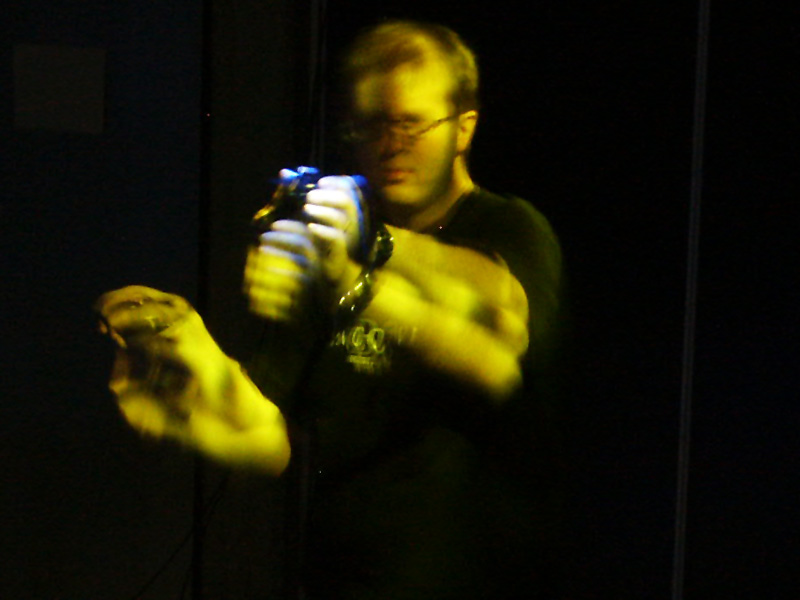
The primary intent of Virtual DJ is to explore motion-tracking technology as an expressive tool for interaction with sound and lights. Virtual DJ uses a proprietary system, the Gesture and Media System, developed by APR of Edmonton. The Gesture and Media System allows artists to “map” an interactive space with sound, light and images, and to have user-movement dynamically control these elements via a small 3D tracker.
At its core Virtual DJ is decidedly “pop,” both in its use of this inexpensive and user-friendly system, and in its focus on dance-based electronica. Eschewing the elitism and over-complexity of CAVE- and helmet-based virtual reality, Virtual DJ instead opts for a garage-VR that can be both comprehended and afforded by a much larger audience. The result is similar to a room-sized theremin combined with a light-organ and an interactive game.
Concept and Technique
The original concept of Virtual DJ was to create a virtual room in which the audience would interact with sound and light by simply moving around with a tracker in hand. With an acknowledgement to the obvious connections with the earlier work of David Rokeby, Virtual DJ is designed as a comparatively populist project, one in which the audience can interact in a very physical, almost aerobic manner to dance-oriented electronic music.
Virtual DJ uses two motion-trackers, one controlling drum and bass, and the second controlling melodies and samples. Borrowing a metaphor from gaming, the piece employs multiple levels of difficulty, with each successive level becoming more complex as the piece progresses. Hot spots in each level allow one user to move the piece to the next level. In addition, certain motions have been standardized to create specific sound effects: raising the hand in the melody tracker usually results in a rising melody, raising the drum and bass tracker results in a change of drum patterns. Similarly, lights are used to give the users a physical sense of the sound zones in the room: when users move within sound zones, lights dynamically change in sync with their movements.
Performance
As a rule, Virtual DJ is first performed by one or two “rehearsed” performers, and after this the audience is invited to take the melody tracker while Steve Gibson takes the drum tracker. This allows the interactor to be simultaneously grounded and in a great deal of control. The personalities of these users come to light in very particular ways when interacting with Virtual DJ — audience members are aware of the structure of the environment from viewing the initial rehearsed performance, but at the same time are free to move within the confines of that structure, varying their performance radically from the person who has gone before.
Net Version
A version of Virtual DJ has been developed to allow two geographically-removed performers to interact with the piece simultaneously. With the help of the programmers from APR, a version of the tracking software allows positional information to be delivered over a high-speed network, letting users at each site hear and see the results of the remote person's motions. A network performance between Steve Gibson at the University of Victoria and Dene Grigar at Texas Woman's University tested this: Dene controlled the sound and light of the melody tracker in Victoria, using Apple's iChat software and a camera to see a projected image of the room in Victoria and hear how she was affecting the audio there, while Steve saw Dene's projected image in his Victoria studio and could infer her movements by a light that moved in a ghostly manner in response.
Related project: Virtual VJ (2011–2015) takes this concept further, uniting the roles of DJ and VJ into one interface.
Bio
Steve Gibson
Steve Gibson is a Canadian media artist and composer. Simultaneously deeply involved with technology and deeply suspicious of its effects, Gibson's musical, multimedia and virtual reality work celebrates both the liberation and paranoia of techno-fetishism. This experimental work reached practical realization in the interactive pieces Cut to the Chase, Telebody, and Virtual DJ. His works have been performed at venues including Ars Electronica, the Whitney Museum of American Art, Banff Centre for the Arts, Festival International Musique Actuelle de Victoriaville, the International Computer Music Conference, European Media Arts Festival, San Francisco Art Institute, and 4th & 6th CyberConf. “[Steve Gibson] is revolutionizing the accepted idea of performance, art and musicianship — a sort of improvisational conductor of our times.” — Darren Stewart, Victoria Times-Colonist
Will Bauer
Will Bauer is an artist and engineer working with “integrated” (as opposed to “multi”) media. He is the inventor of the Gesture and Media System — a wireless 3D virtual media control and integration tool used by artists and corporations around the world — and is currently President of Acoustic Positioning Research (APR) in Edmonton, Alberta. His work in immersive environments has been presented widely across North America and Europe, including at ARCO Fair 95 in Madrid and Ars Electronica in Linz, Austria (1992, 1995, 1998). His collaboration with Rafael Lozano-Hemmer generated a prestigious Golden Nica Prize from Ars Electronica for the piece Vectorial Elevation. Will is also the author of various publications on art and technology, and holds a number of patents in diverse areas of technology.
Video Gallery
Note: these videos are hosted as-is from the original production files. If a video doesn't play in your browser, it may need re-encoding from its original QuickTime format — let me know and we can sort that out.
Documentation
Virtual DJ Documentation
This demo video provides documentation for Virtual DJ — its concept, technology and structure — with excerpts from the Solo, Duet, and Network performances. It serves as a good, general introduction to the project.
Solo
Solo Level 3
An edited video of “level three” of Steve Gibson's performance of Virtual DJ. It shows Gibson controlling different arpeggios and drum and bass loops with his trackers.
Solo Level 4
An edited video of “level four” of Steve Gibson's performance of Virtual DJ. It displays the virtuosic potential of the motion tracker as a musical instrument.
Solo Level 5
An edited video of “level five” of Steve Gibson's performance of Virtual DJ. It illustrates the spatial precision required to perform this last — and most complex — level of the piece.
Solo Performance (full show)
An edited video of Steve Gibson's solo performance of Virtual DJ. Because it shows all five levels of the piece's overall structure, the video allows the viewer to gain an understanding of the way Virtual DJ increases in complexity as it proceeds in time, much like a computer-based game.
Duet
Duet Level 2
An edited video of “level two” of Steve Gibson and Jackson 2Bears' duet performance of Virtual DJ. It shows the way performers use the motion tracking technology as musical instruments in collaboration with one another: 2Bears plays melody while Gibson controls drum and bass.
Duet Level 3
An edited video of “level three” of Steve Gibson and Jackson 2Bears' duet performance of Virtual DJ. It shows the way performers can improvise musical and dance performances using motion tracking technology as well as interact with sound and light.
Duet Level 5
An edited video of “level five” of Steve Gibson and Jackson 2Bears' performance of Virtual DJ. It shows the complexity made possible by alternating samples, arpeggios, and melodies with the “melody tracker.”
Network Performance
Net Level 1
An edited video of “level one” of Steve Gibson and Dene Grigar's performance of Virtual DJ that took place over the internet. While all of the audio equipment running Virtual DJ is housed in Victoria, Dene can listen to her performance and see the studio in Victoria in near-real-time through Apple's iChat software.
Net Level 2
An edited video of “level two” of Steve Gibson and Dene Grigar's performance of Virtual DJ that took place over the internet. Dene uses the tracking system in her “remote” studio in Texas to control the melody tracker in the “local” studio in Victoria. Her relative position in Victoria is represented locally by a light, while her image is projected.
Net Level 3
An edited video of “level three” of Steve Gibson and Dene Grigar's performance of Virtual DJ that took place over the internet. While all of the audio equipment running Virtual DJ is housed in Victoria, Dene can listen to her performance and see the studio in Victoria in near-real-time through Apple's iChat software.
Zurich
Virtual DJ at Digital Art Weeks, Zurich
A montage of Steve Gibson's performance of Virtual DJ during Digital Art Weeks in Zurich on July 15, 2006. Visuals were provided by Corebounce and Randy Adams and were programmed for live performance by Simon Schubiger. Special thanks to Irena Kulka for the video documentation.
Audio
Gallery
A curated selection from performances at the Interactive Institute (Stockholm), University of Victoria, Washington State University, Nottingham, Montreal, and SIGGRAPH — click any image to view full size.